The last big push for Team 2019-2020 AP Biology was the AP exam that we took on Monday, May 18th from 11am-12pm. This AP test was formatted as a 50 minute, two question, free-response style test that coved six main topics in the subject. This is a completely new style than the previous 3 hour, half multiple choice and half free response question test. Overall, I did enjoy the format of the new test since I could take it from home, the timing was a lot shorter, and there were less topics covered. This test and the AP exam season overall is definitely an experience I will never forget.
In case YOU find yourself taking the AP Biology exam next year or further into the future, here are some tips that I’ve compiled from my experience taking this new style of exam.
General Advice:
Take your time reading the question as soon as you start the test.
I ended up reading the same sentence about 5 times because I was reading too fast and couldn’t understand what it was saying.
Make sure to do a normal pre-test taking routine before sitting down at your computer for the exam.
This includes (but is not limited to): getting a lot of sleep, eating a good breakfast, going to the bathroom, taking deep breaths, and of course getting pumped up beforehand!
Be CONFIDENT!
You know a lot more than you think you do, so show some self-love and confidence! Any test does not define you as a person, so don’t be afraid to fail. No matter what happens in life, there are always ways to improve and learn!
What I used to study:
Full length, timed AP exam practice videos on YouTube produced by the CollegeBoard
I was able to practice the timing, grapple with the fast-pace of the test, and review content all at the same time!
Review slideshows posted by Mrs. Girard on Schoology
Really useful, but don’t spend so much time getting all of the details of every process down. Look overall at the main concepts and how everything can be interconnected
Practice FRQ’s on MyAP (CollegeBoard website)
These FRQs are so helpful in finding your weak spot in test taking. Make sure to set a timer so you know how much time you take, and always score yourself afterwards to see where you can improve!
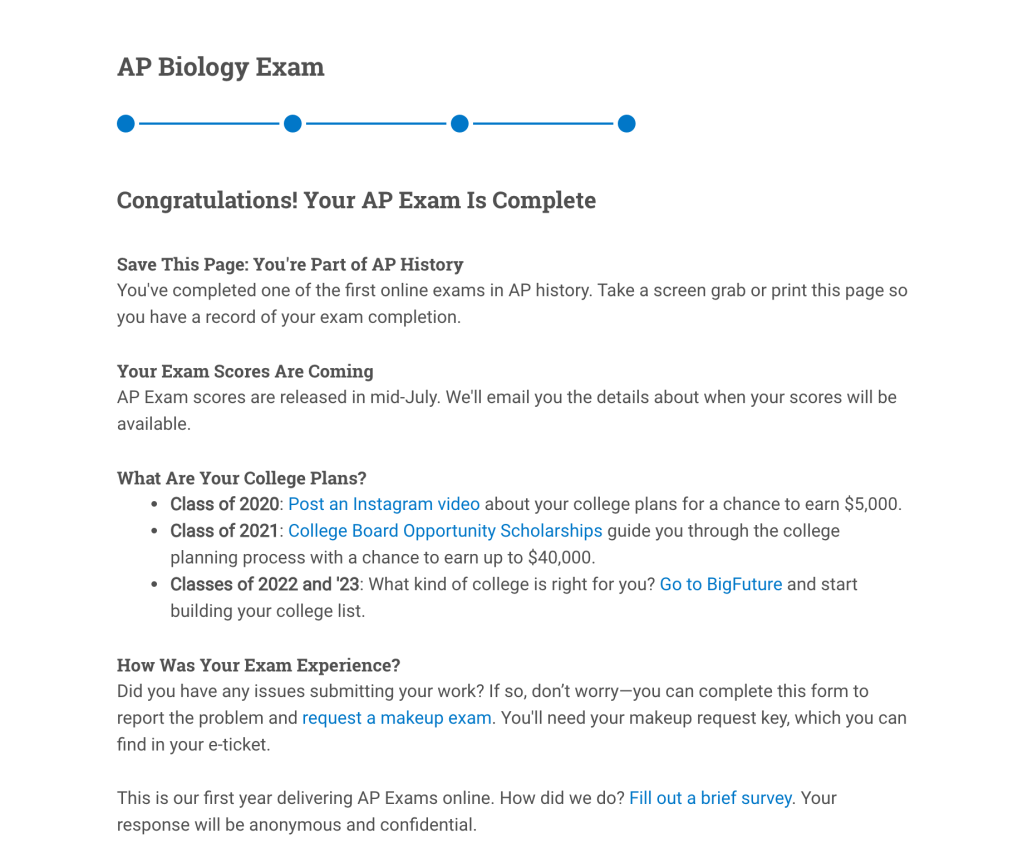
I hope you enjoyed these tips and advice! I was fairly concerned about being unable to submit my exam, so when I got this message at the end of my test I was so relieved. Now we wait for the test results in July!!
My AP Biology Teammate Sofia and I created The Body Systems Chronicle – an in-depth newsletter all about the body systems and the fetal pig dissection! Check it out below! 🙂
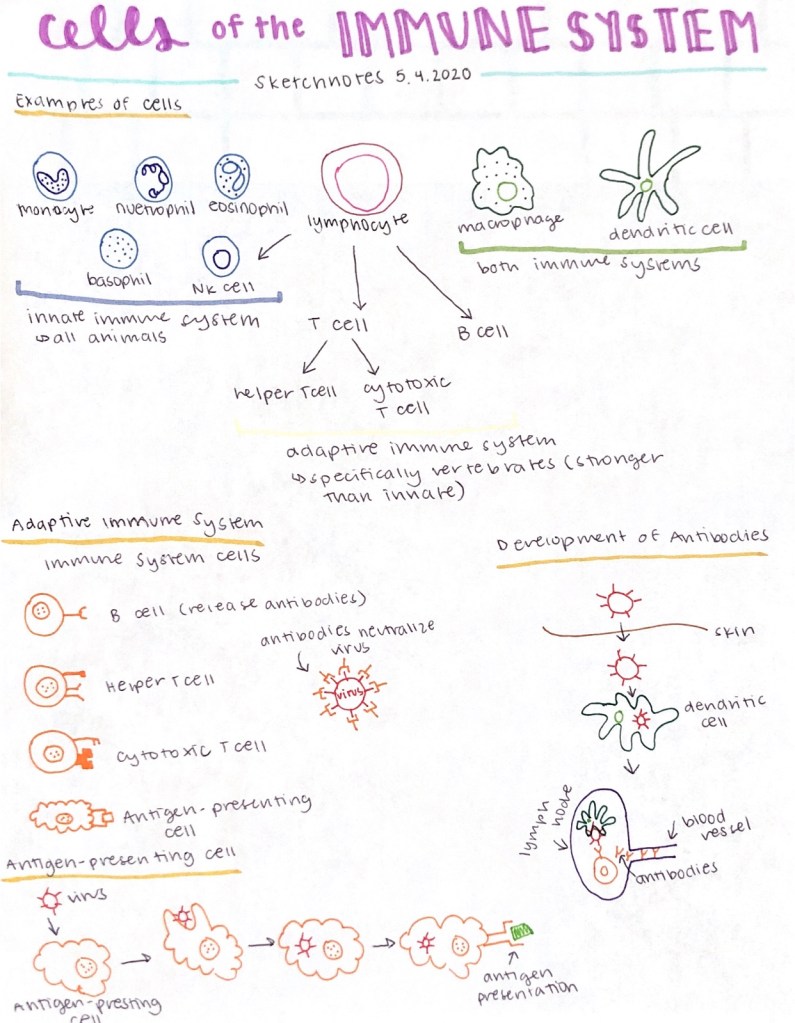
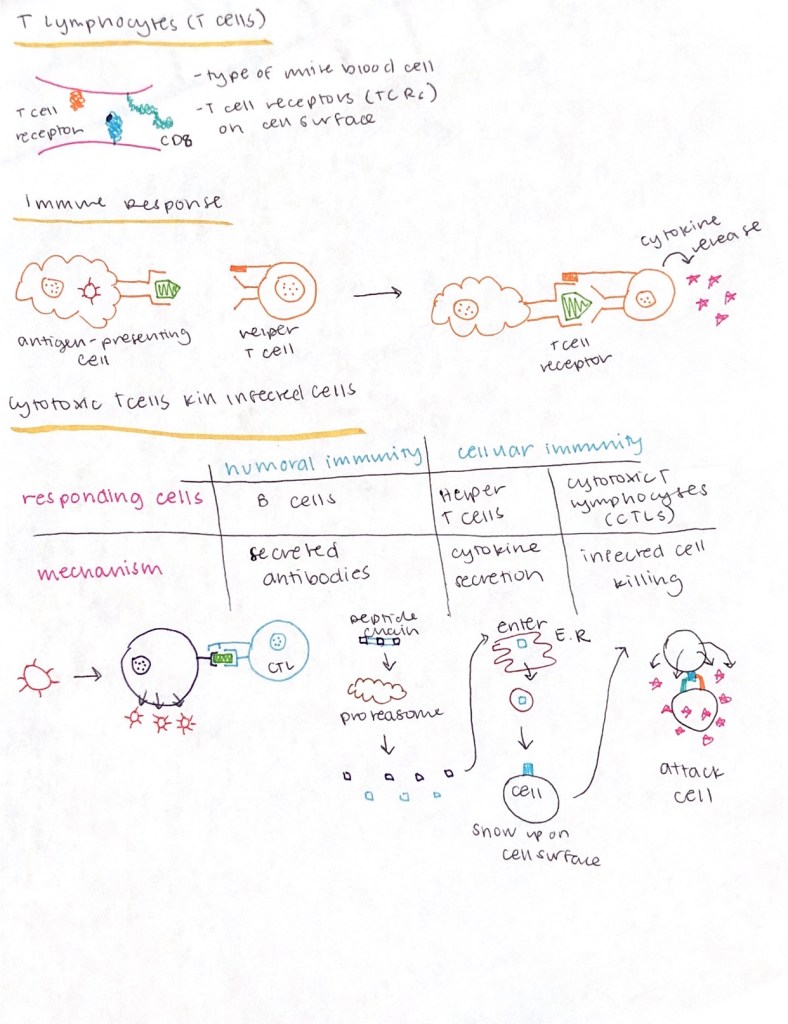
Today I learned a little bit about the Immune System and all of the different types of cells that are associated with it! Check out my sketchnotes to get a deeper understanding 🙂
Botany of Desire is a four-part film that our class watched and discussed together, that talked about how apples, tulips, cannabis, and potatoes have all had an influence in the way humans reproduce organisms. These organisms may not seem like they have something in common, but they are all plants! Each has also been incredibly important in representing how sweetness, beauty, potency, and reproducibility have caused humans to grow mass numbers of these items.
The first part of the video talked about apples, and I found it interesting that the narrator said that plants, such as apples, cause humans to do the plant’s work. Apples would not have been as successful if the fruit was not sweet, easily transportable, and diverse in variety. If the fruit had never been as sweet as it is, there is a good chance that the apple would not be the world’s “universal fruit”. Today, Americans use apples through apple pies, cider, crisps, sauce, and countless other foods. Popular quotes have also been associated with the apple, such as “an apple a day keeps the doctor away,” when people were emphasizing a healthy and balanced diet. Another interesting part of the video was that the fruit in the Garden of Eden was most likely a pomegranate and not an apple, but Renaissance painters decided to paint an apple since the apple was viewed as a “perfect fruit”.
Interested in apples? Watch this video describing why there are so many different kinds of them, produced by Ted-Ed:
The second part of the video, the narrator mentioned how the more beautiful or sweet smelling the flower, the more likely it is to be replicated by humans. This reminds me of the tactic that apples used, because the sweeter the fruit, the more likely someone would want to eat or reproduce it. One thing that surprised me was that after the “tulip mania” faze of the 1600s was over, many people were blaming tulips for being the cause of society’s economic burdens. Many people had spent fortunes on these flowers, but once the flowers were overvalued, they soon became worthless when nobody bought them. These flowers in particular were very popular because they had been infected with a virus that caused them to have two different colors on the bulb of the flower and were extremely rare to find. Behind every famous or popular plant, like apples and tulips, there seems to be times when they are loved and hated by society due to the influence they have on people to reproduce and sell them.
Tulips originally were discovered in Europe, specifically the Netherlands. This country has become extremely popular in producing tulips that are exported throughout the entire world! If you’d like to learn more, check out this video:
The third section of the video covered cannabis, and the reason why people are so attracted to cannabis is because of the chemical THC. This chemical provides people with a high that changes their ability to experience the normal everyday life in a completely new way of thinking. For example, Louis Armstrong used cannabis in order to cause a difference in the way his music was played. Something about the way that he played the notes or blended with the other instruments made people sense a change in his music. One thing that I found interesting was that forgetting information is prefered in nature because it’s simply about editing out the unnecessary information that is stored in the brain. It is not beneficial to the human brain to hold on to every face, object, and sentence that occurs in their life, so it is up to the brain to forget some bits of information. Another way THC is used medicinally is through treating patients with PTSD or anxiety, in order to calm them down or lessen the extreme fluctuations of feelings they may experience.
Another popular chemical found in cannabis is CBD, also known as cannabidiol. This chemical can be found in items such as drinks, lotions, and chocolate, but do not provide the same high as THC. For more information check out this video from Vox:
The fourth and final section talked about the potato, which is an important staple to people all around the world, and originally developed in the Andes region around 8,000 years ago. One thing that I found interesting was that humans found a way to produce many varieties of potatoes on the same hill/mountain depending on the altitude the plant was growing at or if the potato faced the sun. This way, if one crop suddenly died on one side of the mountain, farmers had plenty of other crops they could rely on for food in the same area. The diversity of the potatoes on one mountain alone was able to produce countless varieties in the colors, shapes, and sizes of the potatoes that descended from the original crops. Another thing that I found interesting was that since all of Ireland was dependent on one monoculture of potato, and when a wind-borne fungus was spread throughout the country, the country found itself in a devastating famine. If Ireland had not become dependent on one type of potato, then the death toll in the country would not have been as high. This event was known as the Irish Famine, and one in every eight Irish people died due to starvation.
Potatoes are a staple to human life today and are extremely versatile in their uses. To learn more about the history of the potato, check out this video:
Overall, I really enjoyed watching this movie because it opened my eyes to how plants can manipulate humans to grow and reproduce them. If apples, tulips, cannabis, or potatoes had never been discovered by humans to have many desirable traits such as beauty or versatility, then they never would have been reproduced and delivered to all parts of the world. In this way, plants have a tactic of controlling humans, whether they “know” it or not, to ensure the survival and reproduction of their species.
If you’re interested in watching the full Botany of Desire movie, check out the trailer here:
Works Cited:
“The booming CBD craze, explained”. Vox. Youtube. 28 November 2018.
“The Botany of Desire Trailer”. Kikimmedia. Youtube. 20 May 2013.
“History through the eyes of the potato – Leo Bear-McGuinness”. Ted-Ed. Youtube. 14 December 2015.
“Why are there so many types of apples? – Theresa Doud”. Ted-Ed. Youtube. 22 September 2016.
“Why the Netherlands Is The Tulip Capital Of The World”. Insider. Youtube. 17 April 2019.
Henrietta Lacks; a name you might not be familiar with, but a name that has definitely helped you. The use and application of the cells has shaped modern medicine by contributing to the understanding of influenza, Parkinson’s disease, AIDS, and in vitro fertilization. These cells have literally been all over the world in and traveled to more than 100 countries, which is more than most people do in their lifetimes. But what makes these cells so special?
Quick Summary:
The original HeLa cells were taken from Henrietta Lacks, an African-American woman who was born in 1920 and grew up in Virginia. In 1951, she was diagnosed with cervical cancer, but by then, it was too far in advance for the cancer treatments at the time to be effective. While in the hospital, a doctor took a sample of the mass of cancer cells from Lacks and had them analyzed. They later found out that these cells never stop dividing in a cell culture, which provides an unlimited number of cells to do experiments on. This was an extremely important breakthrough, but instead of Lacks receiving some of the money from the selling of her cells, she never found out that doctors had been making a profit while her family was living in poverty. Fast forward decades later to 1988, the author of the book, Rebecca Skloot, hears about HeLa cells in her college biology class and becomes interested as to the story behind them. Skloot is determined to learn more, and speaks to the family members of Lacks and eventually publishes Lacks’ full story in 2010.
My Reflection:
The Immortal Life of Henrietta Lacks touches on many fields besides science, such as social-justice issues, racism, gender inequality, poverty, and basic human rights and dignity. All people can see themselves in Lacks some way, maybe in how she was discriminated against in the hospital by saying she did not need painkillers, how she was taken advantage of by the doctors took her cells without her consent and made a profit off of them, or how she was struggled to support her family while battling cancer. This book is so encompassing of her story that all people can find some interest in this book, and not just science nerds like me.
I really enjoyed reading this book because it opened my eyes as to how medicine was like during the Jim Crow era, and how modern medicine would not be as advanced without the suffering of so many people who were taken advantage of. This book has caused me to see a strong connection between two fields that I am involved in, social justice through Mock Trial, and science through my passion for Biology. I feel that this is a book everyone should read because you learn more about the history behind normal things you may take advantage for, such as a vaccine. I am thankful that there are laws in place that make sure doctors receive full consent from patients before medical testing, and I hope that in the future, we learn from the suffering of Henrietta Lacks in order to advocate for those who may not have a voice.
Here is Rebecca Skloot’s website, where you can find out more about her experience in writing the novel: http://rebeccaskloot.com/
Here is a TedTalk video that explains more about Lacks’ cells and how useful they were:
When classifying organisms, the Domain Eukarya has four categories, which are Protista, Fungi, Plantae, and Animalia. Three of these names might be familiar, but you might be asking yourself, what is a protist?
All protists share these common traits:
They are Eukaryotic (which means they have a nucleus)
They do not have tissues (cells that have a similar structure and work together to form a specific function)
They live in a moist environment (can be found in all corners of the world!)
One type of protist that you probably know about is seaweed. Even though these organisms look like plants, they are really algae, which are a type of protist!
Here are some reasons why seaweed is not a type of plant:
They do not have roots
They do not have tissues that are found in plants
They can photosynthesize throughout the entire organism (while plants can only photosynthesize in their leaves/stem)
If you would like to learn more about many types of protists and algae, feel free to look through the slideshow that I created with my classmates below:
Here is a video that I found helpful in understanding protists more clearly:
Our first AP Biology field trip has come and gone, and after coming home, I took away so much new information and many fun memories. Take a look at the images below where I explain all of the fun experiences that I had!
Three Scientific Pieces of Information I learned:
Photo by Mrs. Girard
Photo by Mrs. Girard
Photo by Kristen Carpio
Connections to Class:
Photo by Kristen Carpio
Photo by Mrs. Girard
What is Citizen Science?
Photo by Mr. Retelas
My Favorite Memory:
Photo by Mrs. Girard
Conclusion:
Photo by Mr. Retelas
Thank you for reading my blog! I hope these pictures and captions inspired you to go outside of your comfort zone and become curious about places you have in your backyard!
Tomorrow is our AP Biology class’ first field trip and I couldn’t be more excited! We will be traveling to SF Save the Bay in order to restore part of the park and collect data. I think field trips are a great tool for learning because field trips apply education to places we can visit outside of the classroom. We are able to make more connections with what we learn in class to the real world when we are able to step outside and see the things we are learning about in action! Field trips also encourage us to become more curious about how science is applied to all aspects of our life, and trips like the one we are taking encourage us to volunteer and help our planet.
I hope to learn more about more ways that we can make a positive impact on our planet while on the field trip. Also, I would like to learn about how restoring the natural creeks and wetlands for animals in one part of the San Francisco Bay has an impact on all of the people that live around the bay. I want to make a positive difference on the environment, such as allowing the growth of baby animals in the wetlands by restoring the animal’s natural habitat. I am so excited to learn more!
Last Friday, my teammates and I watched a livestream on YouTube of Anusha Shankar, who is a biologist and has studied how hummingbirds enter a state of torpor, where the animal becomes physically inactive in order to minimize energy usage. I found this extremely interesting because I have only heard of animals hibernating during the winter season to not consume as much energy, but never of the state of torpor. Hummingbirds get energy from nectar in plants, but due to their small size they are constantly spending the energy that they consume, and can die within 2 hours if they do not have enough food. In order to save energy, they enter a state of torpor where their body temperature lowers and their brain becomes extremely inactive.
In addition to studying hummingbirds, Shankar currently lives in Alaska and studies Seasonal Affective Disorder (SAD), which analyzes the effects of the amount of daylight overtime in relation to people’s moods. I found this very interesting because I was curious to find out how the weather affects people’s moods. I am still curious to find out whether or not having family that has lived in places with little daylight for generations has an impact on how you respond to the limited amount of light.
I am so thankful to have the opportunity to participate in engaging activities such as this livestream because we are provided with even more ways of learning that we haven’t experienced before. If you would like to watch the livestream that my teammates and I viewed, you can click the link down below. I have also included educational videos on the state of torpor and Seasonal Affective Disorder, so check them out!






 AP Biology with Kristen