
My AP Biology Teammate Sofia and I created The Body Systems Chronicle – an in-depth newsletter all about the body systems and the fetal pig dissection! Check it out below! 🙂
Category: Investigations
The Immune System | 5.4.2020
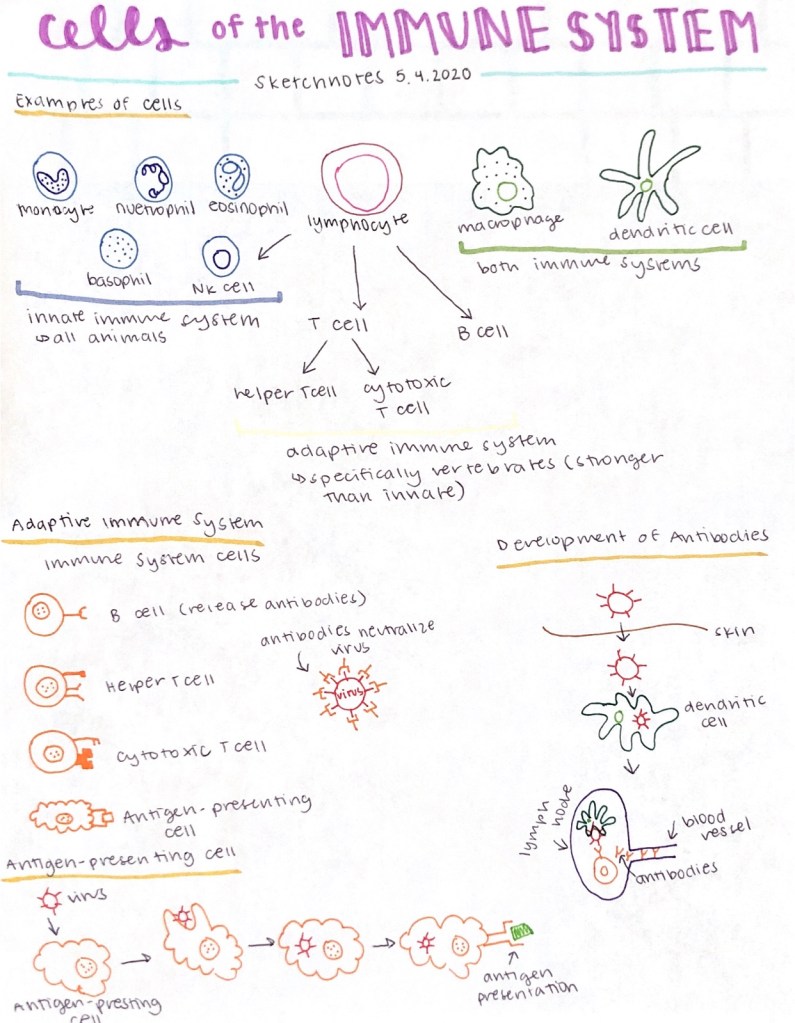
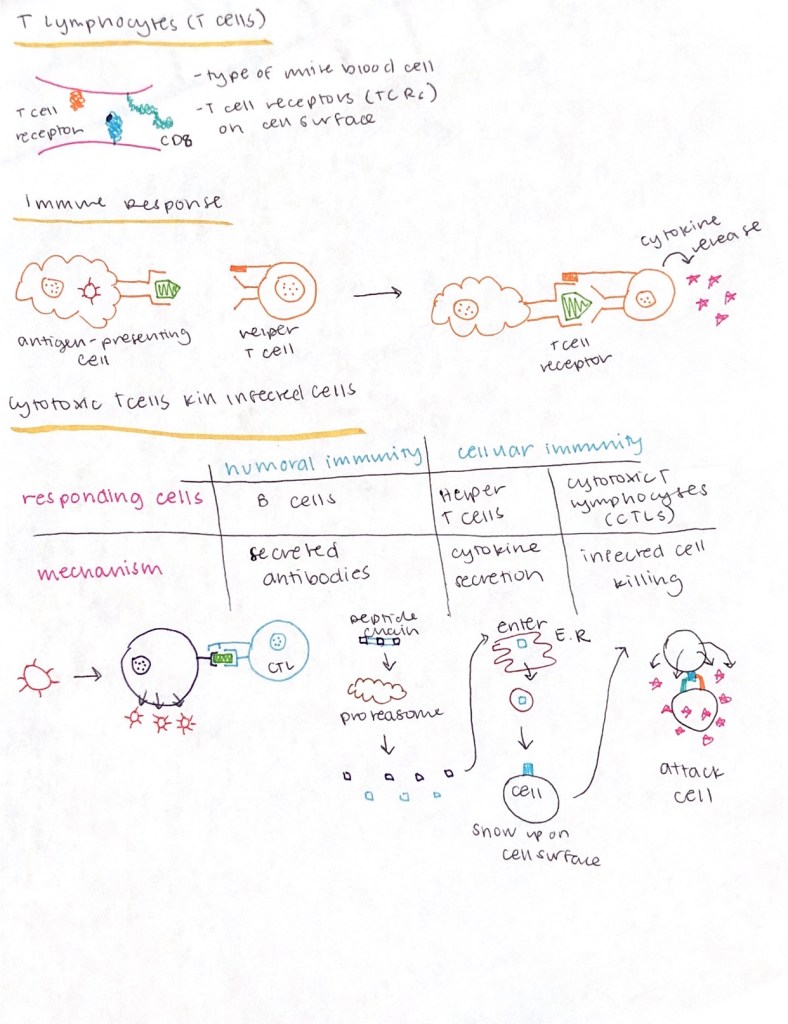
Today I learned a little bit about the Immune System and all of the different types of cells that are associated with it! Check out my sketchnotes to get a deeper understanding 🙂
Protistas! What are those? | 3.18.20
When classifying organisms, the Domain Eukarya has four categories, which are Protista, Fungi, Plantae, and Animalia. Three of these names might be familiar, but you might be asking yourself, what is a protist?
All protists share these common traits:
- They are Eukaryotic (which means they have a nucleus)
- They do not have tissues (cells that have a similar structure and work together to form a specific function)
- They live in a moist environment (can be found in all corners of the world!)
One type of protist that you probably know about is seaweed. Even though these organisms look like plants, they are really algae, which are a type of protist!
Here are some reasons why seaweed is not a type of plant:
- They do not have roots
- They do not have tissues that are found in plants
- They can photosynthesize throughout the entire organism (while plants can only photosynthesize in their leaves/stem)
If you would like to learn more about many types of protists and algae, feel free to look through the slideshow that I created with my classmates below:
Here is a video that I found helpful in understanding protists more clearly:
Works Cited:
MooMoo Math and Science. “Kingdom of Protista”. Youtube, 27 May 2017, https://www.youtube.com/watch?v=kQdRVq0b9Bk&feature=emb_title.
Smallpox | 2.10.20


This work is licensed under a Creative Commons Attribution-NonCommercial 4.0 International License.
Applications of Technology | 1.15.20
Technology is an extremely strong tool that allows scientists to find cures to diseases and disorders. One tool that is used is PCR, also known as Polymerase Chain Reaction, where DNA fragments are copied in order to find where a specific disease or disorder may be in the genome. Learn more about how this technology is used currently in the slideshow above!
Strawberry DNA Extraction | 12.8.19
I worked with my teammates, Sachi and Sofia, in order to extract the DNA from a strawberry. This experiment can be done using any types of berries, like blueberries or raspberries, along with isopropyl alcohol, water, dish soap, and salt. Watch our video down below to learn more about how and why this experiment works!
Chromatography Lab | 10.29.19
Determining the Pigments Absorbed in Photosynthesis in Plants Using Chromatography
Purpose: To use the process of chromatography to determine the pigments that are absorbed through photosynthesis in plants.
Background: The main purpose of photosynthesis is to convert solar energy from the sun into usable chemical energy for plants and other photosynthetic organisms. The pigment that is found in plants is primarily chlorophyll. Chlorophyll is important to plants because chlorophyll absorbs yellow and blue light waves from the sun, while reflecting green, which gives plants a green hue. Chromatography is a technique that is used to separate a mixture. Specifically in this experiment, chromatography will be used to separate the different of molecules of pigment found in green and non-green leaves.
Hypothesis: If a green leaf contains chlorophyll, then the standard Rf value of chlorophyll will be able to be calculated using the process of chromatography. If a non-green leaf contains chlorophyll and other pigments, then the standard Rf values for each individual pigment will be able to be determined using the process of chromatography.
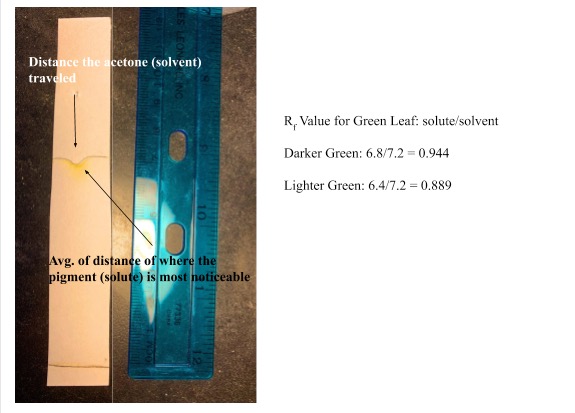
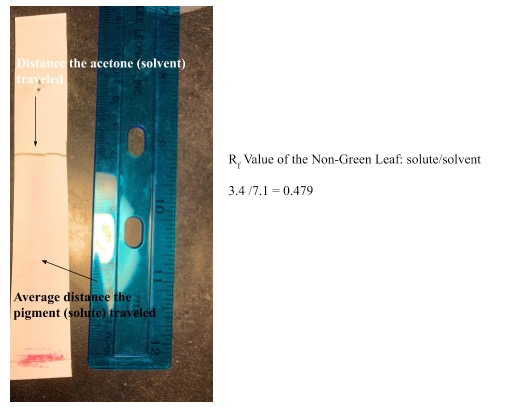
Data:
Questions:
- Chromatography is important because chromatography allows researchers to determine the specific molecules in a mixture. Chromatography is the separation of molecules of a mixture in order to determine each individual molecule.
- The factors that allow chromatography to happen are the solvent, solute, chromatography paper, amount of pigment on the paper, debris left from the coin used to remove the pigment, molecule size, and time.
- The purpose of the chromatography paper in this experiment is to provide a way for scientists to calculate a pigment’s Rf value in order to identify the pigment. As the pigment travels up the chromatography paper, the distance traveled by both the solvent and solute are used to calculate a pigment’s Rf value. The paper also provides a medium for the acetone and leaf pigment to travel upwards.
- The purpose of solvent is to allow the pigments to travel up the chromatography paper. The solvent travels up the paper through cohesion with the solvent and adhesion with the paper.
- The Rf value stands for the relative mobility factor
- The Rf value is useful to scientists because the Rf value allows scientists to determine the pigments in leaves. Since the Rf value of each pigment is specific to the type of pigment, determining an Rf value allows scientists to determine the type of pigments found in a mixture.
- Dunknown signifies the distance that the solute (pigment) traveled.
- Dsolvent signifies the distance that the solvent traveled up the chromatography paper over time.
- In the green chromatogram, two pigments were able to be identified, through the darker green and lighter green pigments. In the non-green leaf, only one pigment was able to be identified, which was the pale red hue in the middle of the paper.
- In the green leaf chromatogram, there were two pigments that were identified, and in the non-green leaf chromatogram, only one pigment was identified. In the green leaf chromatogram, green and yellow colors were heavily saturated around the top of the chromatography paper. In the non-green leaf chromatogram, the more saturated red color was observed to remain at the bottom of the chromatography paper.
- There can be many different types of pigments in a single leaf’s chromatogram. The number of pigments can be determined by the distinct saturated sections on a chromatogram. In photosynthesis, chlorophyll is the most common pigment, and absorbs all wavelengths of light while reflecting some green.
- One question I still have after the lab is, “How does chromatography paper differ from regular paper?”
The Plastic Food Chain | 9.15.19
Hello! Above is my video on how plastic in our food affects human health. Feel free to comment below on your thoughts, opinions, or ways I can improve!
Cell Membrane | 11.8.19
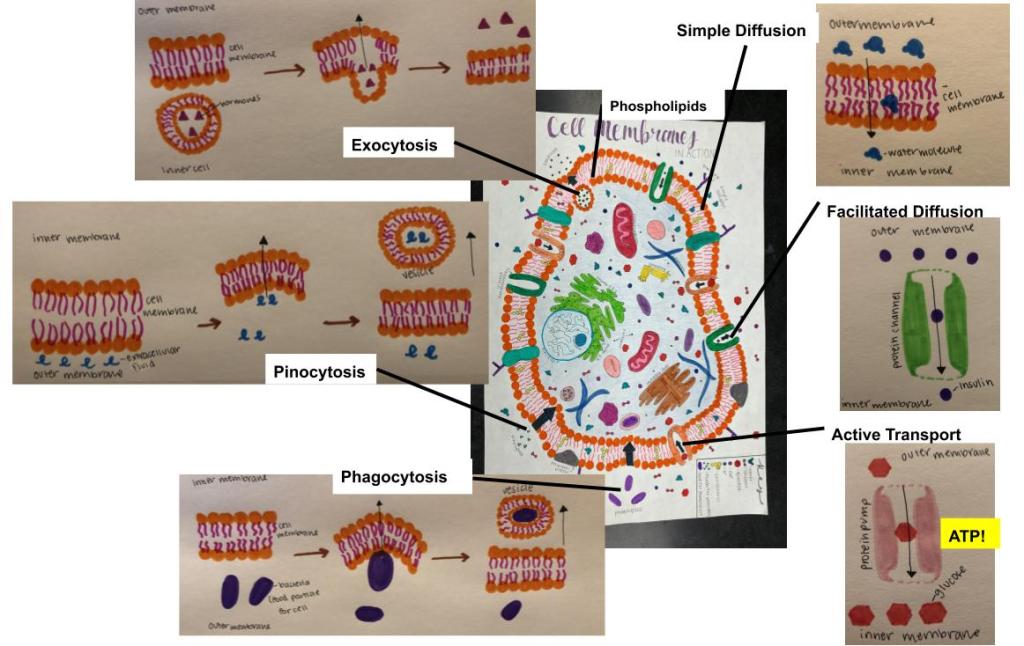
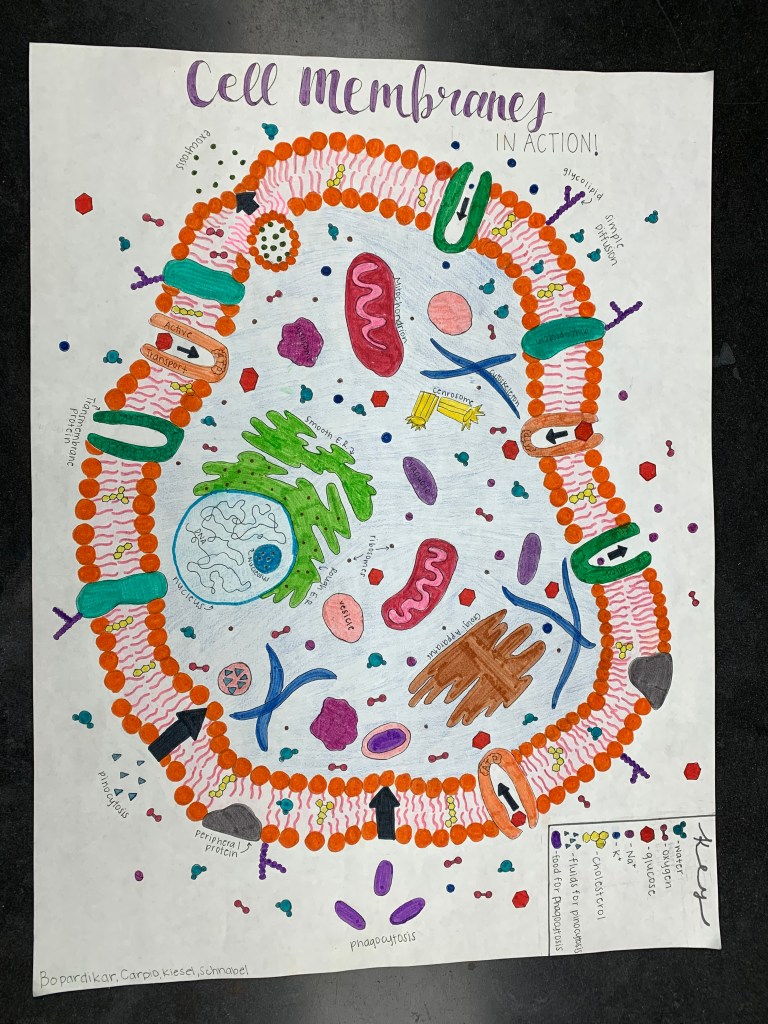
In class, we were split into groups and were able to make our own drawings of cell membranes! Each drawing of the cell shows how molecules are transported through the outer membrane into cell. Some examples of cell transport were exocytosis, phagocytosis, and pinocytosis. Below are some images of the cell that my group and I designed:
Meiosis in Motion | 11.19.19
Below is a video that McKaela and I created to explain the process of Meiosis in animal cells. Check it out!
What is meiosis?
Meiosis is a type of cell division that consists of Interphase and two rounds of Prophase, Metaphase, Anaphase, and Telophase. A single diploid cell starts with 2n chromosomes before the process starts, and in the end, 4 haploid cells are created that have n chromosomes in each cell. Due to the process of crossing over in Prophase I, each haploid cell that is created is genetically different, which allows for genetic variation among individual organisms.
How was the process of producing a stop motion video?
Overall, I would say that the process of making a stop motion video was very difficult and required a lot of patience. Trying to make the video as fluid as possible was challenging at times because sometimes a hand would get in the way of the photo, we would miss a small but crucial step of Meiosis, or the shot didn’t end up looking how we wanted it to. There was a lot of trial and error, but at the end, we are proud of the video that we created. I feel that we included a lot of good information in a way that was easy to understand, and I would be willing to produce another stop motion video in order to gain more experience in the future.
 AP Biology with Kristen